

Introduction
Google Analytics 4 (GA4) brought a new measurement model and privacy first approach, but it also introduces trade-offs. Even though many organizations have adopted it, GA4 has real limitations that can frustrate analysts and marketers. In this article, we cover the key weaknesses, show where data may be misleading, and suggest how to work around them.
Core Limitations
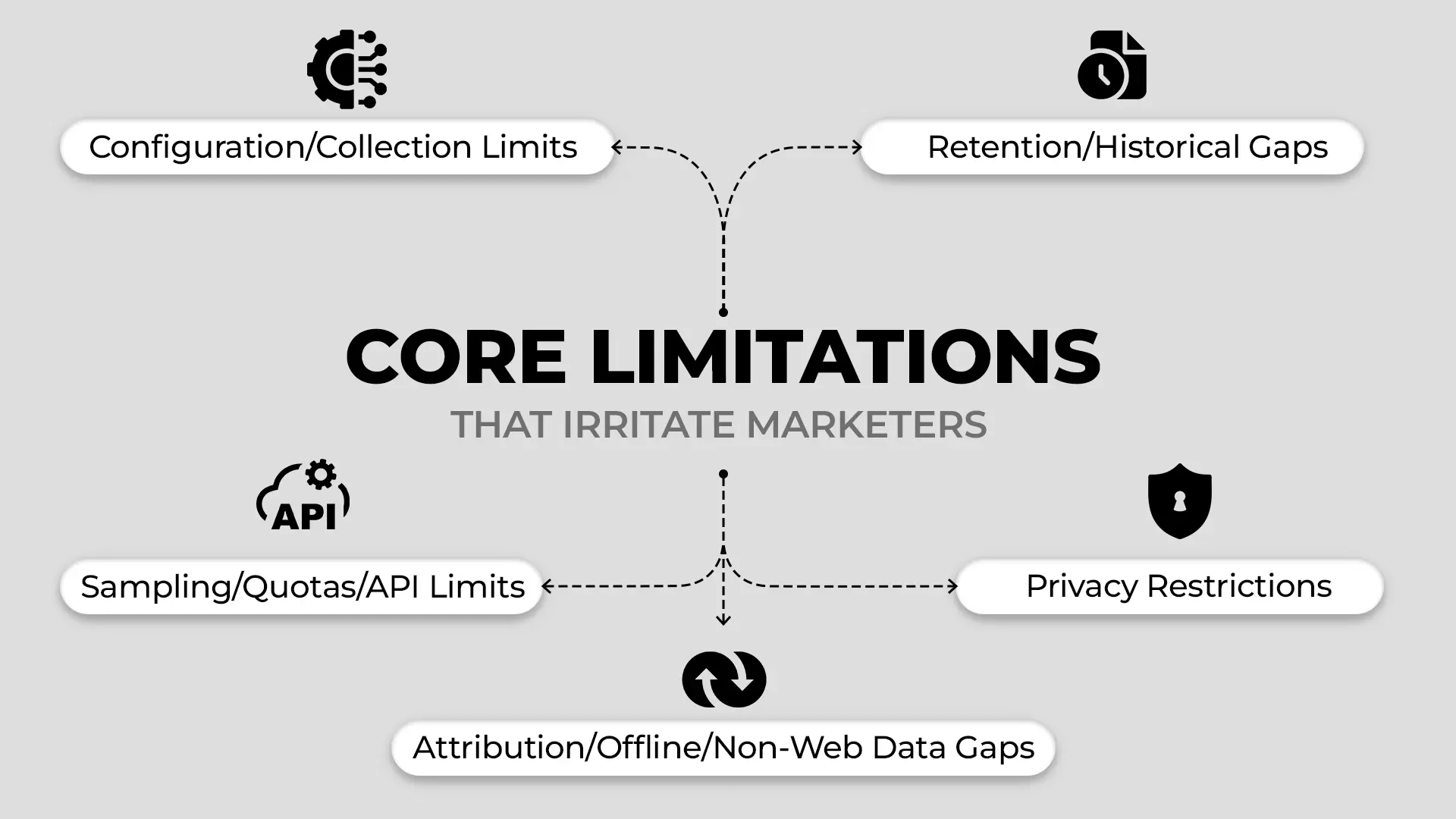
1. Configuration and Collection Limits
GA4 imposes strict caps on how much you can customize and collect. For example:
- You can define up to 50 event-scoped custom dimensions/metrics per property.
- There is a limit of 30 registered custom key events per property.
- GA4 enforces a 16 KB size limit on event payloads, meaning if your event data exceeds that, it may be dropped or not fully processed.
- The number of audiences, saved comparisons, and segments is also capped.
These limits can force you to choose which data matters most—and drop or simplify others.
2. Data Retention and Historical Gaps
- In standard GA, you can retain user-level and event-level data for up to 14 months. Details beyond that become aggregated or unavailable.
- Because Universal Analytics is deprecated, historical data from UA often cannot be integrated directly, leaving gaps in long-term trend analysis.
This limitation makes year-over-year or multi-year comparisons more difficult.
3. Sampling, Quotas, and API Limits
- For large or complex queries, GA4 may sample the data, reducing accuracy.
- The GA4 Data API has quotas and limits for requests (Core, Realtime, Funnel) which restrict how much data you can pull programmatically.
- Reports and explorations have row and cell limits. For example, some explorations may be constrained to 10 million events per query.
These constraints can prevent deep, custom analyses on very large datasets.
4. Attribution & Offline/Non-Web Data Gaps
- GA4’s models tend to favor last-touch or data-driven attribution, but they are less flexible and transparent than many marketers would like.
- Offline conversions (e.g. in-store, phone calls, POS) are not natively tracked; integrating them requires custom solutions (e.g. Measurement Protocol) which can be complex.
- Impression attribution (e.g. views without click) across channels is weak or missing, leading to misattribution.
Thus, GA4 may miss or misassign credit to certain touchpoints in complex customer paths.
5. Privacy & Consent Constraints
- With stricter privacy and cookie consent rules, GA4 may rely on modeled or missing data rather than direct signals.
- Some browsers (Safari, Firefox) limit tracking behaviors via ITP / ETP, making it harder to tie sessions or users across time.
- Because of privacy, IP anonymization is enabled by default, but that may reduce geolocation precision.
These constraints make capturing full, accurate behavioral data more difficult in certain contexts.
Real-World Observations
- Google / BigQuery teams report discrepancies between GA4 and internal systems, especially in conversion counting and attribution accuracy.
- Enterprise marketers and eCommerce brands (Shopify, Meta Ads) note that GA4 is not optimized for data warehouse workflows and offers limited visibility into customer behavior under modern privacy constraints.
- Across industries, marketing teams express frustration with GA4’s rigid reporting, sampling limits, and restricted customization, driving demand for unified, business-focused analytics like ObserviX.
How to Mitigate or Overcome These Limits
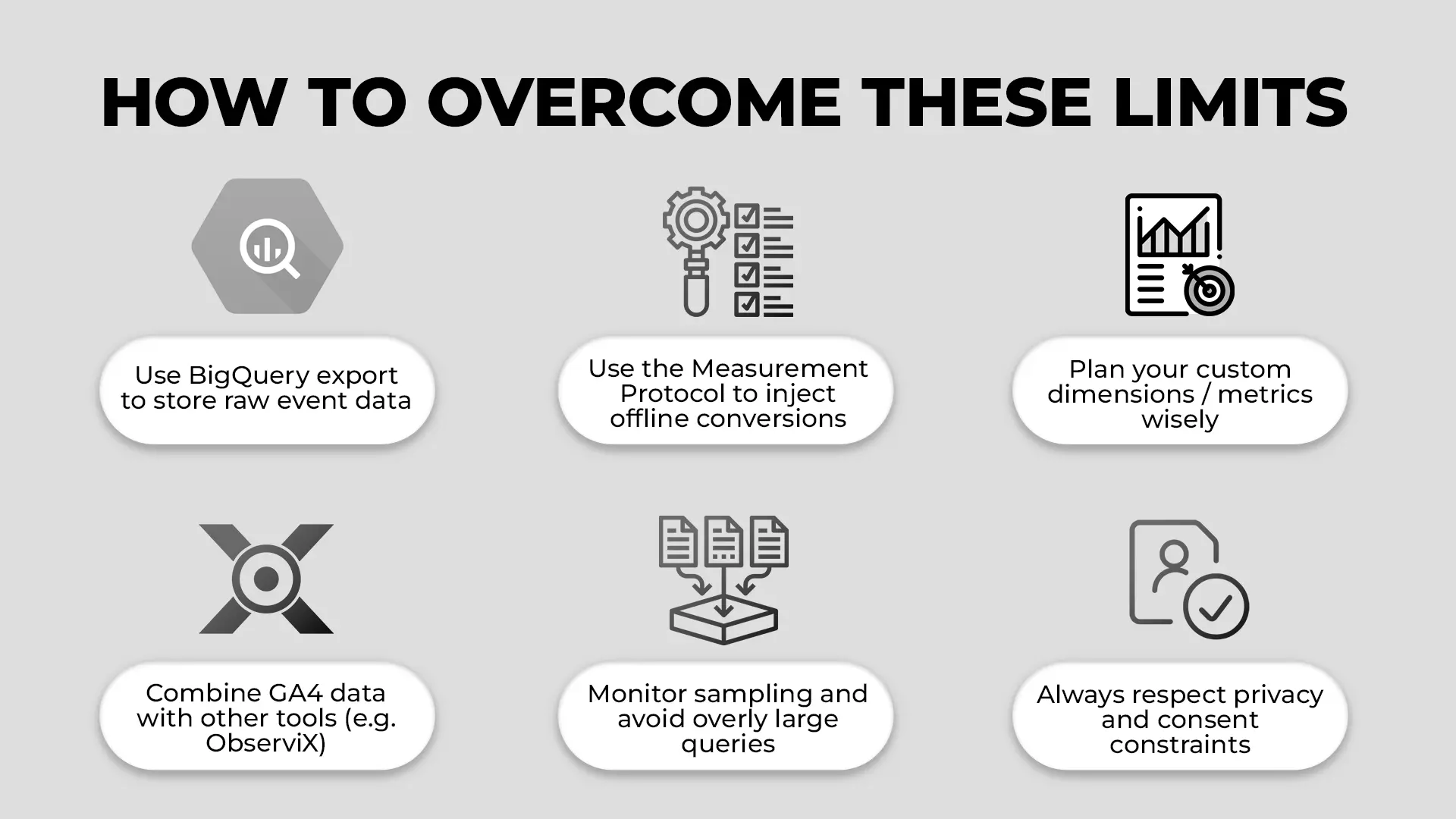
- Use BigQuery export to store raw event data beyond GA4’s retention rules.
- Use the Measurement Protocol to inject offline conversions, server-side events, or other touchpoints not captured by default.
- Plan your custom dimensions / metrics wisely—only include what really matters.
- Combine GA4 data with other tools (e.g. ObserviX) to fill attribution, revenue, and journey gaps.
- Monitor sampling and avoid overly large queries that trigger it.
- Always respect privacy and consent constraints—work with modeled data where needed—but validate with first-party or CRM data where possible.
Conclusion
Google Analytics 4 has become the default analytics platform — but it still leaves major gaps. Its attribution modeling, limited offline tracking, and focus on engagement rather than profitability make it difficult for marketers to connect data with business results.
That’s where ObserviX adds real value. By connecting GA4 with ObserviX, you can:
- combine all channels — organic, paid, social, and offline — into a single analytics view;
- understand your audience better with insights into their interests, behavior patterns, age, gender, and engagement trends;
- see which campaigns actually drive profitable growth, not just clicks or conversions.
ObserviX turns GA4 from a tracking tool into a performance intelligence system — giving you the complete picture behind every marketing decision.